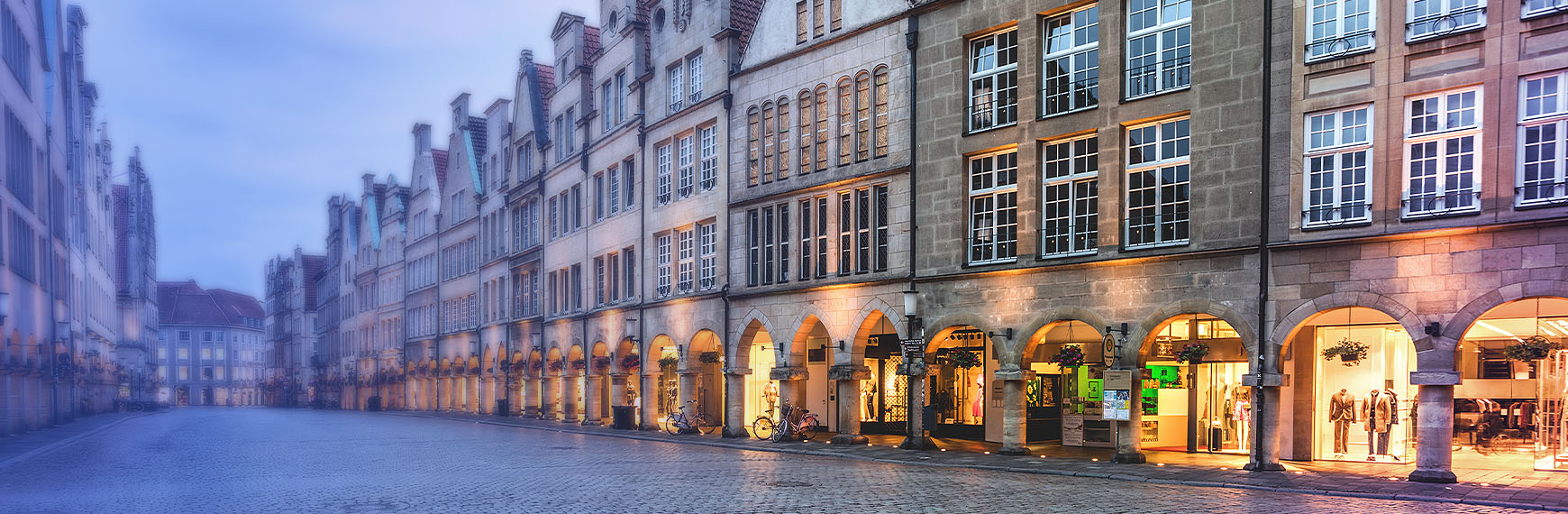
Downtown areas should be vibrant, sustainable, and attractive. But the traditional business model behind them—retail—is becoming less and less viable. Rents are high, customers are shopping online, and many stores are closing. The result: vacant spaces, less variety, and dwindling appeal. Mixed-use concepts could change that.
Storefronts that have been gathering dust for months. Shopping streets that used to be bustling now look like backdrops from a bygone era. This is deterring more and more people. Working from home is widespread, and even work is drawing fewer people into city centers. According to the German Retail Association, around 70,000 stores have closed their doors since 2015. For 2025 alone, the association expects about 4,500 more store closures. About two-thirds of cities estimate their downtown vacancy rates at up to 10 percent. At the same time, there is a growing desire for places where people can meet. Many people want to support local businesses and avoid additional CO2 emissions from online shopping. How does this all fit together—and how can property owners and business owners respond?
One solution is mixed-use real estate
When rent, electricity, and heating costs rise and the customer base shrinks, property owners and tenants need creative solutions to keep the property profitable. One such solution is the mixed-use concept. Mixed-use properties are buildings or complexes that integrate different types of uses into a single project: a bookstore or fashion boutique that also serves as a café. A beauty salon by day and a yoga studio by night. The various uses can include living, working, shopping, leisure, and culture, and can take place either simultaneously or sequentially.
Why Mixed-Use Makes Economic Sense
This trend is evident not only in terms of urban planning but also, increasingly, from an economic perspective. A study published in 2025 by the IREBS Real Estate Academy analyzed over 1,100 transactions in Berlin and Frankfurt am Main and concluded that buildings with a balanced mix of uses more often command price premiums rather than discounts. Greater functional diversification reduces the so-called concentration risk associated with single-use properties, stabilizes returns, and can lead to long-term leaseability. At the same time, mixed-use properties address the scarcity of developable land and urbanization, reduce commuting distances, and thus contribute to sustainability and climate protection. This creates dual added value for investors, owners, and municipalities: economic resilience on the one hand, and revitalization and quality of life on the other.
There are various models for mixed-use concepts
There are various types of mixed-use concepts. Land uses should not be combined arbitrarily, but should offer the greatest possible potential for synergy. Planning should take into account the needs of target groups and legal considerations.
Concurrent Use
One design option is to use the space for two different purposes at the same time, such as a bookstore with a café or a boutique with an integrated bar.
Staggered Use
Even less common is the staggered use of real estate. The goal here is to improve the property’s profitability by utilizing the building for longer periods throughout the day or week. Examples of such concepts include:
- Office spaces and coworking spaces can be used outside of regular business hours for workshops, networking events, or as venues for startups.
- Dining establishments can offer a varied selection to appeal to different target groups throughout the day. A restaurant can serve as a café during the day and be transformed into an upscale restaurant, a bar, or a nightclub in the evening.
Implementation of Parallel Use Under Tenancy Law
There are also various options for structuring the lease agreement. The landlord can either lease to two separate tenants or to a primary tenant, who then subleases portions of the space. A joint lease agreement is also possible.
- If a separate lease agreement is entered into for each unit, the specific terms and conditions for each unit can be taken into account. This arrangement offers a high degree of flexibility in managing the property and clearly delineates the rights and obligations of the tenants and landlords between the parties.
- If the two tenants enter into a joint lease agreement with the landlord, all types of use must be specified. In that case, the tenants do not have the option to terminate the lease individually.
- In practice, it often happens that one of the tenants moves in first and then sublets a portion of the space to another business owner. Even for commercial properties, subletting generally requires the landlord’s consent. However, the primary tenant is also liable to the landlord for the actions of their subtenant.
Lease Agreement Provisions for Successive Tenancies
There are also several design options for sequential use.
- Since lease agreements may be for a limited term, separate lease agreements can also be entered into with different tenants in this case.
- The lease agreement can also provide tenants with the flexibility to use the premises as needed and to adjust the hours of use. In practice, the premises are then rented on a short-term basis and only for limited periods.
- However, for long-term uses that take place one after another, a joint lease agreement among the various tenants or a sublease agreement is generally more appropriate.
It is important to remember that tenancy law makes a strict distinction between residential and commercial leases. It is very common for a building to be used simultaneously as both residential and commercial property, but this can lead to many conflicts.
What needs to be considered from a land-use planning perspective?
The planned uses must comply with the zoning plan. The requirements for obtaining approval are generally stricter for mixed-use properties. However, the Building Land Use Ordinance (BauNVO) is increasingly allowing for greater diversity in land use. Even if the zoning plan does not provide for the planned use, this is no reason to abandon the project immediately. Rather, there is the possibility of an exemption, or a process to amend the zoning plan can be initiated—although the latter can take a very long time.
Which development areas are suitable for mixed-use concepts depends on the specific use. Mixed-use zones and urban areas are expressly designated for the coexistence of residential and non-disruptive commercial uses and will be suitable for most projects. Core areas are also generally suitable for a mixed-use structure. These areas are primarily intended for retail businesses and central economic, administrative, social, and cultural institutions. However, residential units are also permitted.
Even if various land uses are generally permitted under zoning laws in a given area, they must also be compatible with one another on a case-by-case basis. One land use must not cause unreasonable disturbances or nuisances to another land use. Typical areas of conflict include:
- Noise, for example, when restaurants and retail stores are located together
- Odors, for example, when combining dining and living spaces
- Traffic, for example, in a mixed-use area combining commercial activities (including deliveries) with residential use
What needs to be considered from the perspective of building codes?
All building code requirements must be complied with for all types of use. A change in use generally requires a building permit, unless an exception applies. The types of use may also be mutually exclusive.
Mixed-use properties are generally classified as special-purpose structures. This has procedural implications: As a rule, a comprehensive—rather than a simplified—building permit process must be followed, which involves a detailed review of all public law regulations by the building authority. As a result, obtaining permits is more complex, time-consuming, and therefore also more costly.
In the area of fire safety as well, different levels of requirements apply to different types of use, and each must be observed. For example, if a café is added to a boutique, additional fire safety measures may need to be implemented. Additional emission control regulations must also be observed. To this end, careful floor plan design—possibly including buffer zones between the different uses—is advisable.
New Developments: Lawmakers Are Picking Up the Pace
Under the so-called “Construction Turbo,” which took effect on October 30, 2025, (Section 246e of the German Building Code, BauGB), municipalities may, for a limited period until the end of 2030, deviate from building code requirements and permit residential uses—such as through the conversion of vacant commercial properties—without amending the zoning plan. Innovative noise protection solutions are intended to make it easier to live near commercial areas. In addition, in May 2026, the Federal Cabinet approved the “BauGB Upgrade,” which is set to take effect on January 1, 2027, and is intended to declare housing construction in tight markets to be in the overriding public interest. To support this, the KfW Program 266 “Commercial to Residential” has been promoting the conversion of vacant properties since July 1, 2026, with grants of up to 30,000 euros per newly created residential unit. In addition, the planned “Building Type E” is intended to enable simplified building standards.
Mixed-use properties can help sustain the retail sector
Mixed-use concepts are often a good solution for properties that would otherwise be unprofitable. They can help preserve many stores and make downtown areas more attractive overall. Local governments are also interested in preserving downtown areas.
When designing the legal framework, the objectives, advantages, and disadvantages should be carefully weighed.