Today, businesses face constant pressure to adapt. Rising costs, regulatory requirements, technological upheavals and strategic realignments mean that business models, structures and individual divisions must be put under the microscope. When decisions become inevitable, you need a partner who understands the complexities involved and takes responsibility.
Our Restructuring Solutions combine legal, tax, business and technological expertise into an integrated advisory approach.
Restructuring is neither an isolated legal project nor a purely operational measure. It affects the organisation, processes, assets, employees and stakeholders in equal measure. It can only be successful if all relevant perspectives are brought together at an early stage. This includes portfolio and structural measures (carve-outs, spin-offs, divestitures), operational efficiency programmes, financial restructuring and insolvency-related options.
KPMG Law and KPMG work in close collaboration where necessary. In this way, we ensure that legal issues, economic implications and operational implementation are coordinated from the outset, both nationally and internationally.
Our strength lies in the integrated management of complex restructuring projects. We bring together all relevant disciplines within a clear project framework, featuring transparent governance, coordinated workstreams and reliable project management.
We use proven methods, technological solutions and central management tools as a single source of truth, alongside KPI-based reporting. This enables us to make sound decisions, set realistic timelines and maintain controlled budgets.
We draw on many years of experience in corporate restructuring. Nevertheless, every company, every situation and every decision is unique.
Our aim is to work with you to develop the solution that best suits your situation.
Rising energy prices, new trade barriers and structural changes pose significant challenges for companies. The experts from KPMG Law and KPMG discuss in a webcast series what options companies have to position themselves for the future.
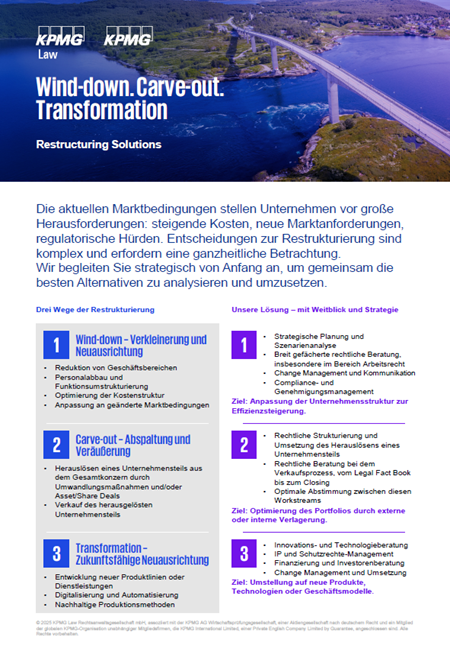
The first webcast focused on the possibility of relocating, closing or downsizing business units (keyword “winddown”) and discussed strategic aspects of restructuring and the legal framework, planning and implementation of necessary personnel adjustments, the use of data analytics for well-founded decisions and
Voluntary programs and transfer companies in practice.
The second webcast focused on the possibility of carve-outs and sales of business units and discussed the strategic background of a carve-out, guiding principles and carve-out concept, carve-out vs. wind-down, carve-out financials, planning and implementation of the actual carve-out, integration with the sales process and provisions in the company purchase agreement.
In the third webcast, the transformation of business areas was discussed, focusing on current drivers of strategic transformations, requirements for obtaining subsidies and the role of state funding in transformation, economic evaluation with practical calculation approaches and operational challenges and strategic fields of action for companies.
Whether partial downsizing, relocation or complete closure – the orderly withdrawal from corporate divisions requires forward-looking planning, legal diligence and tax sensitivity.
Companies are sometimes faced with the challenge that certain areas no longer function as planned – whether due to financial bottlenecks, changes in the market environment or strategic realignments. In such situations, decision-makers are faced with the complex question: should the division be transformed, sold or closed?
Selling a part of a company is like performing surgery on a living heart. The clean and data protection-compliant allocation of data is a particular challenge. If companies do not take care of this at an early stage, it can delay or complicate the carve-out or even jeopardize the continued success of the target. Dr. Jyn Schultze-Melling, Partner at KPMG Law Rechtsanwaltsgesellschaft mbH and Markus Limbach, Partner at KPMG AG Wirtschaftsprüfungsgesellschaft, explain how companies should proceed.
If the buyer and seller of a company are unable to agree on a purchase price, earn-out agreements have recently been used more frequently. They stipulate that at least part of the purchase price is dependent on the performance of the target company after the acquisition. But does this always make sense? Dr. Daniel Kaut, Partner at KPMG Law Rechtsanwaltsgesellschaft mbH, and Christin Müller, Partner at KPMG AG Wirtschaftsprüfungsgesellschaft, explain in a joint podcast when the contracting parties should resort to earn-out clauses and what needs to be considered.
Rising interest rates, the recession and possibly stricter regulations are creating a clear trend: more and more parts of companies are up for sale. Regardless of the reason companies divest individual divisions, a carve-out process can be very challenging. Maximiliane Prüm, Partner at KPMG Law Rechtsanwaltschaft mbH, and Dr. Florian Jung, Partner at KPMG AG Wirtschaftsprüfungsgesellschaft, describe what buyers and sellers should think about in a joint podcast.
We support international reorganizations with technical expertise and tech-based project management
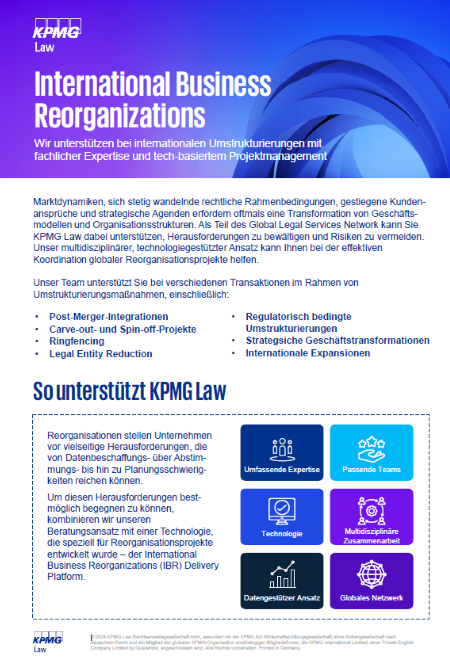
We support international restructurings with technical expertise and tech-based project management
Partner
Site Manager Nuremberg
Cluster Lead Corporate/M&A
Bahnhofstraße 30
90402 Nürnberg
Tel.: +49 911 800929944
chensel1@kpmg-law.com
Partner
THE SQUAIRE Am Flughafen
60549 Frankfurt am Main
Tel.: 49 69 951195565
mtrayer@kpmg-law.com
Partner, Performance & Strategy
KPMG AG Wirtschaftsprüfungsgesellschaft
Partner, Performance & Strategy
* KPMG AG Wirtschaftsprüfungsgesellschaft
© 2026 KPMG Law Rechtsanwaltsgesellschaft mbH, associated with KPMG AG Wirtschaftsprüfungsgesellschaft, a public limited company under German law and a member of the global KPMG organisation of independent member firms affiliated with KPMG International Limited, a Private English Company Limited by Guarantee. All rights reserved. For more details on the structure of KPMG’s global organisation, please visit https://home.kpmg/governance.
KPMG International does not provide services to clients. No member firm is authorised to bind or contract KPMG International or any other member firm to any third party, just as KPMG International is not authorised to bind or contract any other member firm.