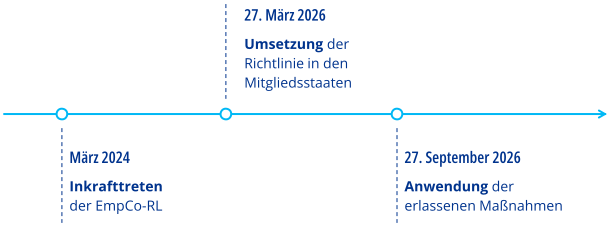
Environmental claims are becoming increasingly risky for companies. Due to the Empowering Consumers Directive (EmpCo), much stricter rules will soon apply to environmental claims and sustainability labels. The directive will apply from September 27, 2026.
In Germany, the European requirements are implemented in the Unfair Competition Act (UWG). The Third Act Amending the UWG, which implements the EmpCo requirements, was promulgated in the Federal Law Gazette on February 19, 2026. It is intended to better protect consumers from misleading environmental claims and sustainability seals.
What EmpCo regulates
The changes to the UWG with regard to environmental claims and sustainability seals include defining the term “environmental claim”, adapting the prohibition of misleading statements and adding additional prohibitions to the so-called “black list”.
Concept of the environmental statement
Environmental statements are voluntary statements or representations. They can take the form of text, images, graphics or symbols.
They are intended to convey that a product, brand or company has a positive or no impact on the environment or is less harmful to the environment.
This includes labels, brand names, company names or product names that are used in commercial communication, in particular in advertising.
Sustainability reporting in accordance with the Corporate Sustainability Reporting Directive (CSRD) does not generally fall within the scope of EmpCo, as these reports are not voluntary and are not aimed at consumers. The situation is different if a company uses environmental statements from the sustainability report in its advertising. In this case, the requirements of EmpCo must be complied with.
Unverifiable general environmental claims will be unfair in future
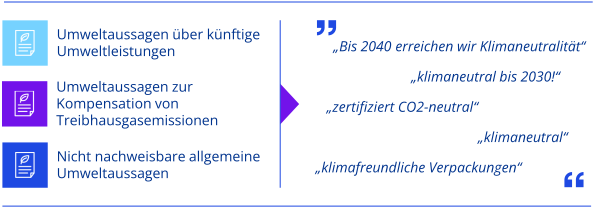
In future, general environmental claims will be unfair if the company cannot prove that they are based on a recognized outstanding environmental performance.
Because vague terms such as “environmentally friendly”, “green” or “biodegradable” give consumers the impression that the products have special environmental properties that have been tested, it must be possible in future to prove that the advertised outstanding environmental performance actually exists.
Statements such as “We will achieve climate neutrality by 2040” will also not be permitted in future if the commitment is not set out in a detailed and realistic implementation plan that is regularly reviewed by an independent external expert.
Sustainability seals must be based on a certification system
In addition to environmental claims, the legislator also focuses on sustainability seals. Sustainability seals are voluntary trust seals or quality marks. They serve to emphasize or promote the ecological or social characteristics of a product, process or business activity.
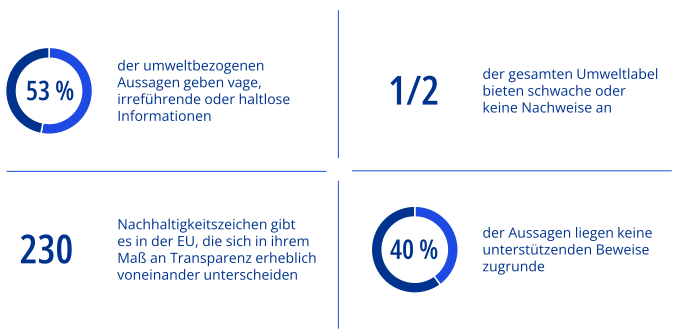
In a 2020 study, the EU found that around half of the eco-labels are based on weak or no evidence and that there are a total of 230 sustainability labels in the EU, which vary considerably in their level of transparency.
In future, sustainability seals may only be used if they are based on a certification system or have been established by government bodies. It is not permitted to display a sustainability seal that is neither based on a certification system nor established by government bodies.
EmpCo sets minimum requirements for the certification system in terms of transparency and credibility. For example, the system must be monitored by a third party whose competence and independence from both the system owner and the user of the seal is based on international, EU-wide or national standards and procedures, for example by demonstrating compliance with the ISO 17065 standard. A separate audit structure is therefore required. The trader is obliged to check whether the sustainability seal awarded to him fulfills these requirements. To do this, the retailer must check the publicly available conditions. If you use a sustainability seal that does not comply with EmpCo, this will be at your own expense.
In principle, sustainability seals that do not meet the requirements of EmpCo must be removed from commercial communication from September 27, 2026. If retailers identify sustainability seals on packaging that do not comply with the new rules, they have the option, for example, of covering them with stickers or providing additional information at the point of sale.
What are the penalties for violating EmpCo?
Violations of EmpCo regulations are primarily pursued by entitled competitors, consumer and competition associations and regularly lead to warnings to which companies should respond quickly. If the company does not comply with the warning, there is a risk of injunctions and injunctive relief. Under certain circumstances, claims for damages and even fines may also be considered.
How companies should act now
Companies should prepare for more transparency and stricter requirements for environmental claims at an early stage. The following steps are recommended:
Inventory: Check commercial communication.
Check environmental claims for greenwashing risks
Creating awareness of greenwashing risks within the company, for example through guidelines and training courses
Making commercial communication greenwashing-proof
Conclusion
One thing is clear: greenwashing will be punished even more consistently in future. Those who actively deal with the new rules now and adapt their processes and communication will minimize risks and can position themselves as credible pioneers in the market.
With our approach to policy management, you can streamline processes, save resources, and communicate clear, easy-to-understand policies to your employees digitally.
Two critical vulnerabilities in the PHP programming language are threatening web applications and digital products worldwide. The Federal Office for Information Security (BSI) has warned…
The rapid advancement of artificial intelligence presents corporate leadership with diverse and far-reaching decisions. These decisions concern not only the selection and deployment of appropriate…
The current issue of PERSONALFÜHRUNG (10–11/2026) features two articles by female experts from KPMG and KPMG Law.
In the article “Will AI Save the Day?…
Planning and permitting procedures do not always have to delay construction projects. The law provides several options for expediting the process. To take advantage of…
Cyber incidents are among the most complex claims scenarios for insurers. Ransomware attacks, in particular, can paralyze entire IT infrastructures—with enormous financial consequences. Insurers for …
Car dealerships should use the time remaining before the new Consumer Credit Directive takes effect to systematically review their financing and sales processes for regulatory…
AI analyzes, makes recommendations, and helps make decisions. But who bears the consequences if it’s wrong? KPMG Law experts Nikolaus Vincent Manthey and Sabrina Riesenbeck…
Downtown areas should be vibrant, sustainable, and attractive. But the traditional business model behind them—retail—is becoming less and less viable. Rents are high, customers are…
KPMG Law Rechtsanwaltsgesellschaft mbH (KPMG Law) and KPMG AG Wirtschaftsprüfungsgesellschaft (KPMG) advised the Munich-based technology group Rohde & Schwarz on its acquisitions of NEOSAT GmbH…
KPMG Law Rechtsanwaltsgesellschaft mbH (KPMG Law) and KPMG AG Wirtschaftsprüfungsgesellschaft (KPMG) advised Diehl Defence on its acquisition of the aerial imagery database Dr. Carls GmbH.…
KPMG International does not provide services to clients. No member firm is authorised to bind or contract KPMG International or any other member firm to any third party, just as KPMG International is not authorised to bind or contract any other member firm.