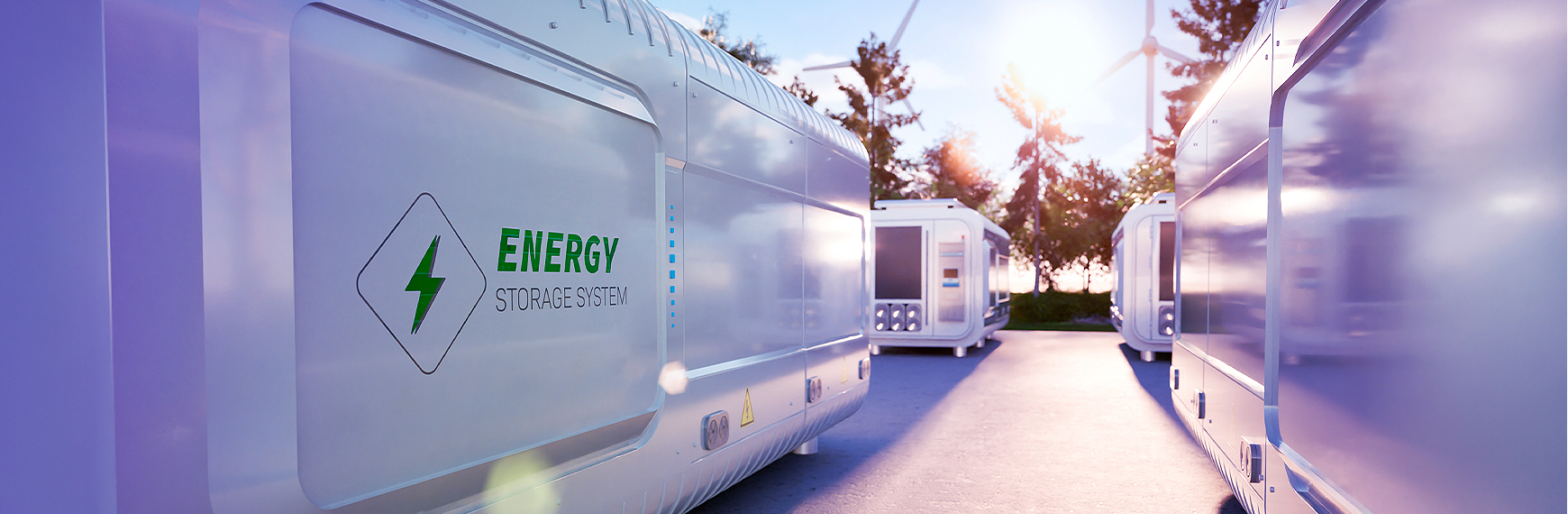
On September 18, 2025, the Federal Network Agency published a draft for the “Market integration of storage systems and charging points” (MiSpeL for short). For the first time, energy storage systems (battery energy storage system – “BESS”) and charging points can benefit from EEG funding even if they are not operated exclusively with electricity from renewable energy sources. This means that BESS operation can be optimized in a market-oriented manner and the existing flexibility potential can actually be exploited. The determination procedure must be completed by June 30, 2026 at the latest. From then on, the new funding options can be applied in practice.
Funding currently only for BESS that exclusively consume and feed in green electricity
To date, BESSs have only been able to benefit from the exclusive option under Section 19 (3a) of the German Renewable Energy Sources Act (EEG). This means that a BESS is only entitled to the market premium or feed-in tariff if it exclusively consumes electricity from renewable energies or mine gas for the purpose of intermediate storage within a calendar year and feeds the electricity generated in this BESS back into the grid. In order to take advantage of this funding opportunity, it is necessary to prove that no grid electricity and therefore (potentially) so-called gray electricity was fed into the BESS. This restriction ultimately hinders the integration of BESS into the electricity system.
The application of the exclusivity option also prevents levy netting, as this privilege requires the storage of grid electricity purchases. In addition, the use of charging points for intermediate storage is generally excluded under the exclusivity option.
Legislators have created the legal basis for two new funding opportunities
The legislator has created the conditions for two new funding opportunities, but these will only be applicable once the MiSpeL determination procedure that has now been initiated has been completed: The Act Amending the Energy Industry Act, known as the “Solar Peak Act”, which was passed on February 25, 2025, has introduced significant innovations to the EEG and the Energy Financing Act (EnFG). In addition to the existing exclusivity option pursuant to Section 19 (3a) EEG, the deferral option in Section 19 (3b) EEG and the flat-rate option in Section 19 (3c) EEG were added. BESS operators now have the opportunity to choose between these options. In addition, bidirectional charging points, i.e. those that can absorb and release energy, are included in the law for the first time. An amendment to Section 21 EnFG allows for the proportionate maintenance of the levy balance.
The legislator’s aim is to improve the framework conditions for active market participation using BESS and at the same time to promote the grid and system integration of electricity from renewable energies. According to the explanatory memorandum to the law, this is urgently needed to curb temporary generation surpluses. BESS should use their storage function to increase flexibility both on the demand side (electricity procurement with dynamic tariffs) and on the supply side (price-optimized direct marketing) and also benefit from arbitrage transactions in a bidirectional combination.
The Solar Peak Act has also introduced the regulation that charging points for electric cars will be treated like BESS in future. A charging point can collect electricity and could later feed it back into the grid. The green share would then be eligible for funding under the deferral or flat-rate option.
The changes will only apply once the Federal Network Agency has made its determinations
However, the funding options can only be utilized once the Federal Network Agency has defined the details for measuring and calculating the eligible electricity volumes. This determination procedure has now been set in motion by the MiSpeL draft.
The MiSpeL draft will be discussed publicly in a workshop on October 1, 2025. Comments can be submitted until October 24, 2025.
Federal Network Agency presents details on demarcation and flat-rate option
In future, BESS operators will be able to choose between two additional procedures in addition to the exclusive option in order to benefit from EEG funding. Operators of charging points for electric cars will only be eligible for the two new funding options.
The deferral option pursuant to Section 19 (3b) EEG
Under the demarcation option, in the case of BESS and charging points that accept mixed electricity, only the proportion that comes from renewable energies is subsidized. The eligible share must be precisely determined and verified. It is therefore “delimited” from non-eligible gray electricity.
The Federal Network Agency is authorized to create a basis for calculating the eligible share. According to the MiSpeL draft, the eligible electricity is to be determined by taking measurements every 15 minutes. The prerequisite is measurement and data provision in compliance with calibration law. Annex 1 of the MiSpeL draft contains specific formulas for the exact mathematical determination of the eligible share and takes into account various case scenarios for the combination of RE systems with BESS and/or charging points.
Although the accrual option requires considerable measuring and billing effort, it also ensures a high level of accuracy and legally compliant determination of the respective electricity quantities. It is therefore primarily aimed at larger systems and professional operators who want precise billing.
The flat-rate option pursuant to Section 19 (3c) EEG
Compared to the deferral option, the scope of application of the flat-rate option is more limited. It is only possible in the case of joint operation of solar installations and one or more BESS. In addition, all systems involved must be operated by the same operator, the installed capacity of the solar systems must be at least 30 kW and a maximum of 500 kWh per kW of installed capacity per calendar year may be subsidized.
Under the flat-rate option, a flat-rate share of the electricity fed into the grid from BESS can be considered eligible for support without each individual quantity of electricity having to be precisely measured and allocated. This is done on the basis of certain framework circumstances and within certain orders of magnitude. If the flat-rate value is exceeded, the excess electricity is deemed to originate from the grid and is not eligible for funding. Details are regulated in Annex 2 to the MiSpeL draft.
This option is particularly suitable for smaller BESS or charging points for which costly metering is not economically viable.
Rapid conclusion of the determination procedure is desirable
It is to be welcomed that the Federal Network Agency has now presented the draft for determining the market integration of storage facilities and charging points. The MiSpeL specifications have yet to be reviewed under state aid law, which is to take place in parallel with the specification procedure.
It will only be possible to apply the deferral and flat-rate option once the precise billing and verification regulations of the MiSpeL draft are legally binding and approved by the state aid authorities. A specific date for the entry into force of the MiSpeL provisions is not yet known.
It is to be hoped that the Federal Network Agency will not make full use of the statutory deadline of June 30, 2026, but will conclude the procedure earlier. This is desirable in view of the urgent need to make the electricity grid more flexible. Until then, BESS and charging point operators are recommended to prepare for the new regulations, particularly with regard to the application of the flat-rate option, and to set up an appropriate metering system.