AI is a blessing for many companies, but it can also quickly become a curse, especially when authorities use the technology to uncover legal violations by companies. This is exactly what the German Pension Insurance (DRV) intends to do in its company audits. It has developed a tool called KIRA that scans digital documents and searches for anomalies and risk patterns. This can be fatal for companies, especially when using external personnel. This is because the options for detecting violations were previously limited. According to its own information, the DRV audits around 400,000 companies a year with around 1,700 employees. This means that if less than one day is available for each audit, many violations fall through the cracks. In addition, the DRV has previously only inspected payroll accounting during company audits. Only since 2025 has it also been auditing financial accounting, where invoices for external personnel are normally recorded.
Customs are also to be given new powers in the fight against undeclared work – and therefore also against bogus self-employment and the covert hiring out of workers: The draft law to modernize and digitalize the fight against undeclared work, which was passed by the Federal Cabinet in August 2025, allows the use of digital and data-supported inspection and investigation methods, including artificial intelligence.
The consequences of uncovered cases are serious: there is a risk of high back payments of taxes and social security contributions, fines and even criminal prosecution of those responsible for evading social security contributions and payroll taxes.
KIRA searches specifically for cases of bogus self-employment and concealed temporary employment
The DRV can use KIRA to uncover cases of bogus self-employment and concealed temporary employment.
We speak of bogus self-employment if a natural person is formally commissioned as self-employed – usually via a contract for work or service – but is actually treated as an employee (in particular subject to instructions) and/or is organizationally integrated into the company. This may be the case, for example, if the person works according to instructions, keeps fixed working hours, works exclusively for a client or uses the client’s work equipment. If the DRV determines pseudo self-employment, the contractual relationship is retroactively deemed to be dependent employment. The company must pay wage tax and social security contributions, usually including the employee’s share. In addition, there is a risk of late payment penalties, fines and, depending on the extent, criminal prosecution for the persons responsible (usually management).
Hidden temporary employment exists if a company provides personnel to another company via a service contract or contract for work and services and this external personnel – as before – is integrated into the client’s business and/or is subject to the client’s instructions. In such cases, the contractual service is not provided on the basis of an employee leasing agreement within the meaning of the German Temporary Employment Act (AÜG). If an unauthorized assignment is discovered, the same legal consequences apply in principle as in the case of bogus self-employment; in particular, wage tax and social security contributions must be paid subsequently. And: an employment relationship is established between the assigned personnel and the client – with all rights and obligations. There is also the threat of fines and – depending on the extent – criminal prosecution.
In future, the DRV will use KIRA to specifically search for such constellations in its tax audits. And it can find them, even if the violation was not intentional on the part of the company.
The way KIRA works
The employment of bogus self-employed persons or the use of covert employee leasing are rarely intentional. Rather, they are often the result of ignorance and carelessness, both in the commissioning, drafting of contracts and invoicing as well as in the organization of the actual collaboration.
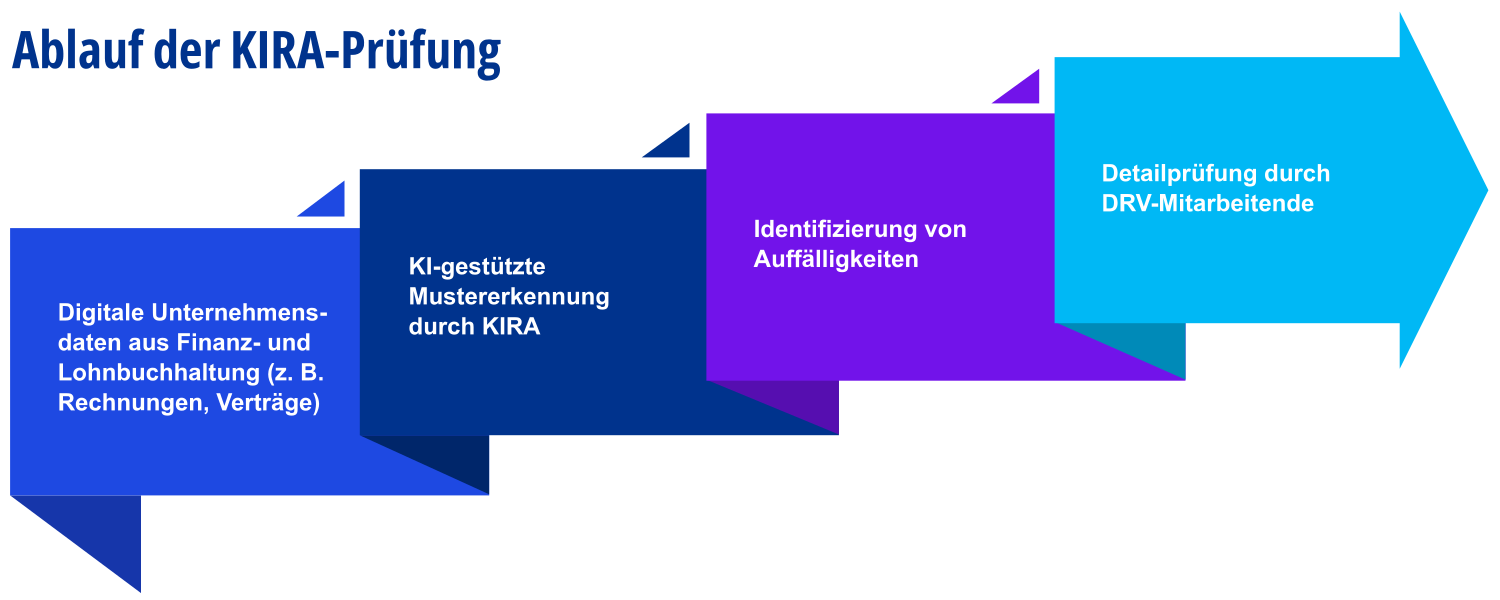
In future, KIRA will evaluate written documents in particular during tax audits. The software scans all digitally available company data and searches for patterns and anomalies. These include, for example, unusually high or low payment amounts and missing supporting documents. The employees of the audit service follow up on the anomalies found and can use these clues to start detailed audits.
Information on bogus self-employment and concealed temporary employment
In practice, the distinction between self-employment and dependent employment remains one of the biggest challenges when using external personnel.
The contracts concluded, the service descriptions and the invoices often provide indications of bogus self-employment and concealed temporary employment or dependent employment.
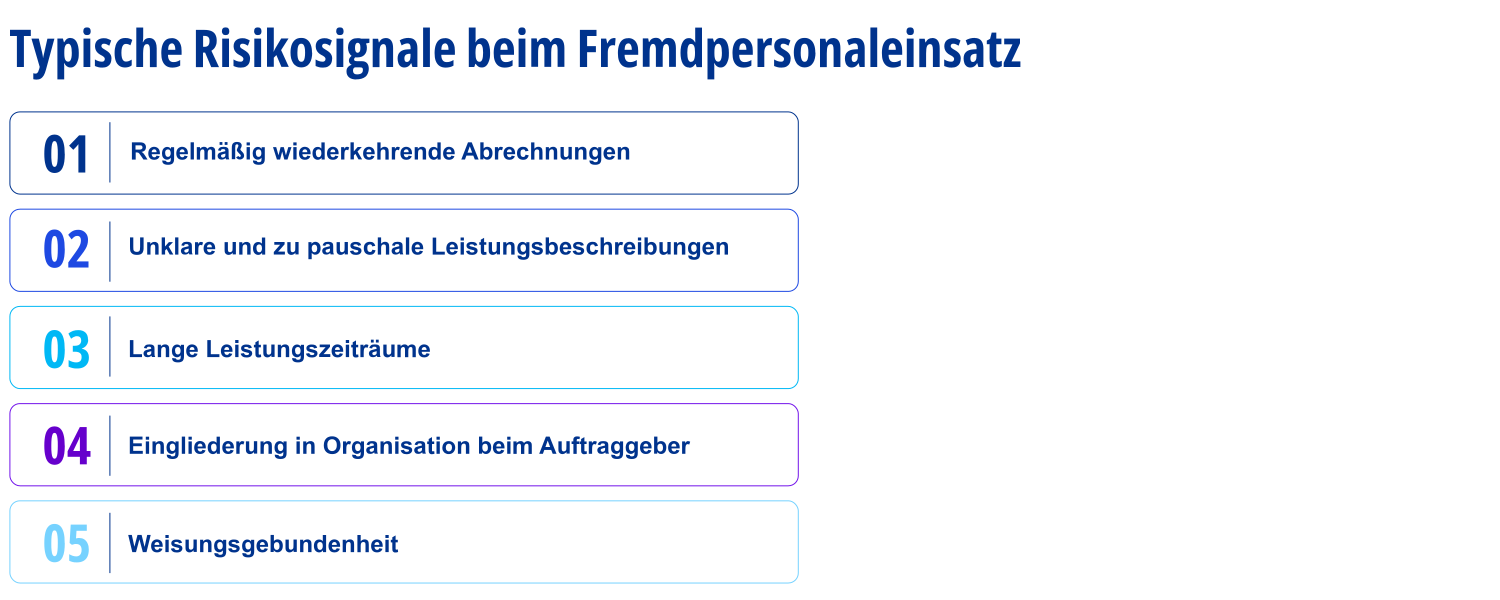
Typical risk signals are
- regularly recurring or uniform settlements,
- a lack of concretization of the commissioned services or
- a performance period that corresponds to the character of permanent cooperation.
Such indications can be quickly recognized by KIRA and lead to a reassessment of the contractual relationships.
Legal violations and errors are usually due to ignorance
As a rule, the purchasing department commissions external services. The employees there do not always have the necessary knowledge of employment and social security law or are sufficiently sensitized. The HR department is often not consulted because no employment relationships are to be established. In some companies, the assignment is also carried out directly by specialist departments such as Facility Management or the IT department. This makes it even more difficult to recognize the associated risks.
It is also not uncommon for the actual implementation of the collaboration to deviate from the contractual arrangement, for example through de facto integration into company structures, the use of internal work equipment or close coordination with managers.
It is precisely this discrepancy between the contractual situation and actual implementation that is increasingly becoming the focus of company audits and can now also be better recorded quantitatively and qualitatively by the DRV thanks to AI-based evaluations.
Companies should establish an external personnel compliance process
In view of the impending economic and personal liability consequences and the significantly increased risk of detection due to KIRA, every company should establish an external personnel compliance process. This should ensure that external assignments do not involve any risks of bogus self-employment or hidden employee leasing. As the DRV’s assessment practice, laws and, in particular, case law are constantly evolving, this process should also be regularly reviewed and adapted as necessary.
Companies should prepare well for the upcoming tax audits with KIRA. In particular, they should check digital documents relating to the commissioning of external services in the financial accounting and purchasing systems – ideally also with AI support – for indications of dependent employment. If such indications are actually discovered, the company should check whether there are any legal obligations to act in the past. For the future, an external personnel compliance process should also be set up in such a way that the risks of dependent employment are excluded as far as possible and therefore economic and personal liability consequences are avoided.