A German tech company had been paying license fees to a contractual partner in Panama for years without ever having any problems. However, few people knew that Panama has been on the EU’s “blacklist” since 2021.
In 2024, the management received unpleasant mail from the tax office’s fines and penalties department. Withholding tax should have been withheld and paid on the license payments. The company was accused of tax evasion. There was even the threat of a prison sentence. This made it clear that the rules had changed.
What had happened?
The tech company had been paying said license fees to the contractual partner in Panama for years. This was previously uncritical from a tax perspective. However, this changed with the Tax Haven Defense Act (StAbwG). This came into force on June 25, 2021 and has been gradually implemented since then. From 2022, German companies that pay remuneration to contractual partners based in a tax haven will be obliged to withhold and pay withholding tax. In the case of the tech company, this added up to a considerable amount over the years. It was even accused of a particularly serious case of tax evasion.
The link to tax havens is often overlooked
What the management did not know: Tax havens are countries that are listed in the German Tax Haven Defense Ordinance (StAbwV). This in turn is linked to the EU blacklist, which has included Panama since December 24, 2021. The tech company had missed this. And this also happens to many other companies.
The EU lists tax havens in a “blacklist”
The Council of the European Union has been pursuing the goal of combating tax avoidance and aggressive tax planning for years. To this end, the Code of Conduct Group on Business Taxation evaluates countries that promote abusive tax practices outside the EU with the consequence of undermining the tax revenues of EU member states. These countries are included on the EU list of non-cooperative jurisdictions for tax purposes, the so-called blacklist. The list is reviewed and updated twice a year. With the Tax Haven Defense Act, Germany has implemented the Council’s objective at national level. And the EU blacklist also applies in Germany via the Tax Haven Defense Ordinance.
This affects all those who are liable for tax in Germany and conduct business transactions with individuals, partnerships or asset pools such as limited companies and trusts in non-cooperative tax jurisdictions (tax havens).
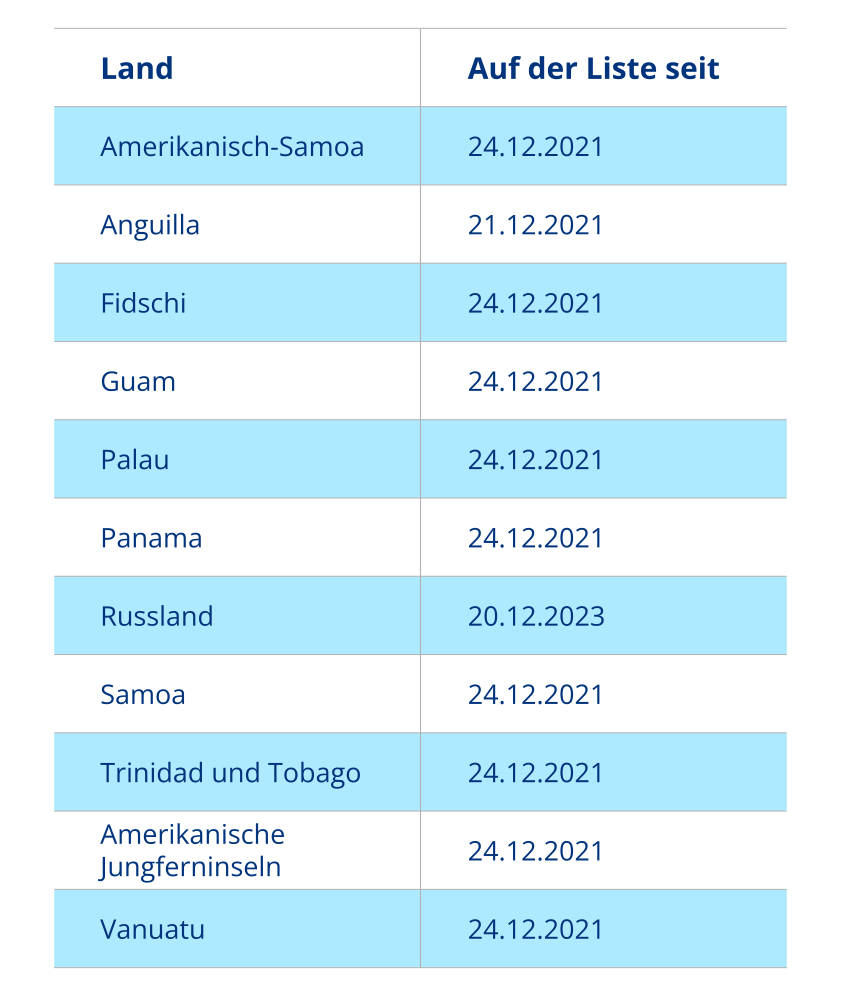
The following eleven countries are currently on the list: American Samoa, Anguilla, Fiji, Guam, Palau, Panama, Russia, Samoa, Trinidad and Tobago, U.S. Virgin Islands and Vanuatu.
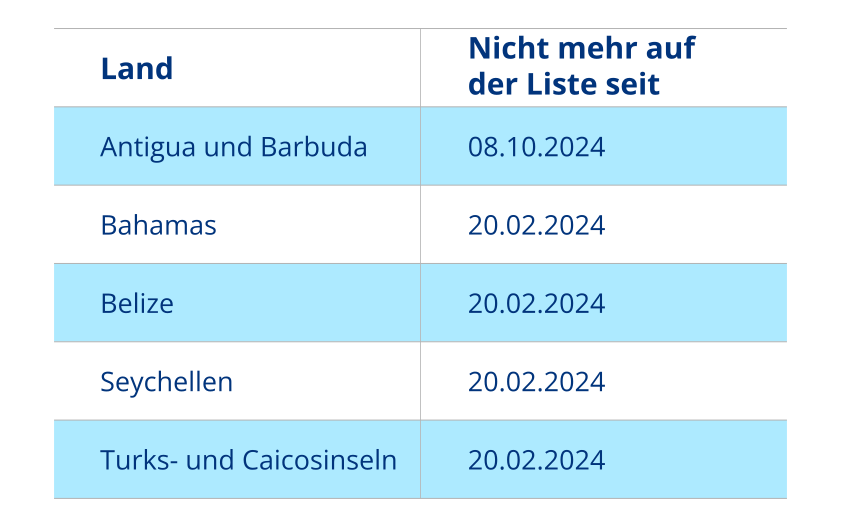
The following countries were removed from the list in 2024 and are therefore no longer covered by the StAbwV and StAbwG: Antigua and Barbuda, Bahamas, Belize, Seychelles and Turks and Caicos Islands.
The StAbwG provides for four defensive measures against tax havens
The StAbwG contains a total of four extended defensive measures for the listed countries. These are
1. refusal of operating expenses
Payment flows to a listed country may not be claimed as business expenses or income-related expenses (Section 8 StAbwG).
2. stricter add-back taxation
Income from subsidiaries in a listed country is subject to stricter add-back taxation (Section 9 StAbwG).
3. withholding tax
The German contracting party must withhold 15 percent withholding tax plus solidarity surcharge on payments and remuneration that flow into a listed country and pay it to the Federal Central Tax Office (BZSt) (Section 10 StAbwG).
4. discontinuation of tax exemptions for profit distributions and sales of shares
Tax privileges and DTA exemptions for dividends and capital gains no longer apply (Section 11 StAbwG).
The four defensive measures – and thus the associated tax obligations – come into or cease to apply with a time delay. The example of Panama shows the following:

With the country’s removal from the EU blacklist, the sanctions under the StAbwG also cease to apply.
Companies should also monitor the greylist
In addition to the blacklist, the EU maintains another list of countries known as the “greylist”. It lists tax jurisdictions that do not yet meet all international tax standards but have agreed to implement reforms. It represents a preliminary stage to the blacklist. These countries are effectively under observation. Companies should also include these countries in an early warning system, as they could soon appear on the blacklist. Vietnam and Turkey are currently on the list.
Companies should keep an eye on the lists and the StAbwG
Violations of the StAbwG happen quickly:
- A country with which business relations have existed for a long time is suddenly blacklisted and nobody notices.
- The marketing department commissions an influencer who lives in a tax haven and no one has informed the tax department.
- Risks can arise for logistics or travel companies if ships and aircraft refuel in listed countries, catering has to be paid for or employees stay overnight in hotels.
Companies should therefore take precautions and keep an eye on the blacklist, ideally also the greylist, in order to be able to react to the new situation in good time.
In addition to the tax-related sanctions, the StAbwG also provides for increased obligations to cooperate for those affected, which in turn requires separate records (Section 12 StAbwG). Failure to do so may result in tax penalties. Failure to comply with the extended defensive measures can result in accusations of tax evasion, as in the case of the tech company.
The tax authorities have now also dealt intensively with the topic: Since June 14, 2024, there has been a comprehensive BMF circular on the StAbwG.
If a company discovers business transactions with business partners in tax havens, the tax department or tax advisor should be contacted. If tax misconduct has already occurred, tax returns must be corrected immediately. A voluntary disclosure can avoid a penalty.
In the case of the tech company, things turned out well once again. With a well-prepared disclosure and clear communication, the tax authorities were convinced that there was neither intent nor reckless conduct. The tax was paid subsequently. Criminal proceedings were discontinued in 2025. “I don’t need that again!” said the managing director. And he doesn’t need to, because he has now integrated the issue into his compliance system.
Conclusion
Anyone who conducts business transactions with contractual partners abroad should keep an eye on the list of countries and the Tax Haven Defense Act. It does not always have to be exotic countries that are affected by this, as the listing of Russia in 2023 shows. Including the topic in a compliance system and raising employee awareness helps to avoid expensive surprises.
You can gain further insights in our free webinar series on white-collar criminal law. Register now: Commercial criminal law in focus